

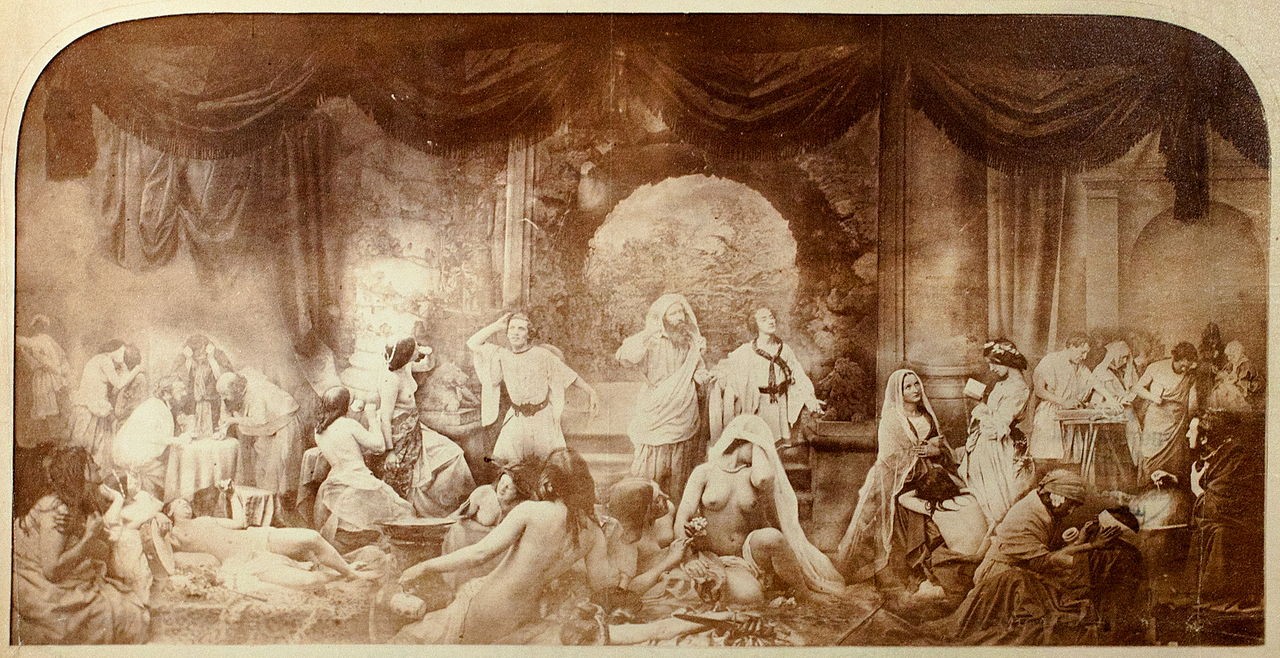
In 1856, [Rejlander] made his best-known allegorical work, The Two Ways of Life. This was a seamlessly montaged combination print made of thirty-two images (akin to the use of Photoshop today, but then far more difficult to achieve) in about six weeks. First exhibited at the Manchester Art Treasures Exhibition of 1857, the work shows a man being lured to paths of vice or virtue by good and bad angels. The image’s partial nudity, which showed real women as they actually appeared and not the idealised forms then common in Victorian art, was deemed ‘indecent’ by some. Rejlander was also accused of using prostitutes as models, although Rejlander categorically denied this and no proof was ever offered. Reservations about the work subsided when Queen Victoria ordered a 10-guinea copy to give to Prince Albert. Victoria and Albert would go on to purchase three copies of the work, all of which are now lost.
Despite this royal patronage, controversy about The Two Ways of Life in Scotland in 1858 led to a secession of a large group from the Photographic Society of Scotland, the secessionists founding the Edinburgh Photographic Society in 1861. They objected to the picture being shown with one half of it concealed by drapes. The picture was also shown at the Birmingham Photographic Society with no such furor or censorship. However, the Photographic Society of Scotland later made amends and invited Rejlander to a grand dinner in his honour in 1866, held to open an exhibition that included many of his pictures.
https://en.wikipedia.org/wiki/Oscar_Gustave_Rejlander
See a higher resolution version here: https://en.wikipedia.org/wiki/File:Oscar-gustave-rejlander_two_ways_of_life_(HR,_sepia).jpg
.jpg)